We often get asked about Food Storage Shelf Life. It’s somewhat of a tricky question because there are varying opinions on shelf life of different foods from different experts. Most of the traditional food storage foods have very long shelf lives which is why we use them for long term food storage. However there are definitely some exceptions to that rule. It’s best to always double-check with your individual company that you are buying from on what THEIR recommended shelf life is, but that being said you can count on some general guidelines.

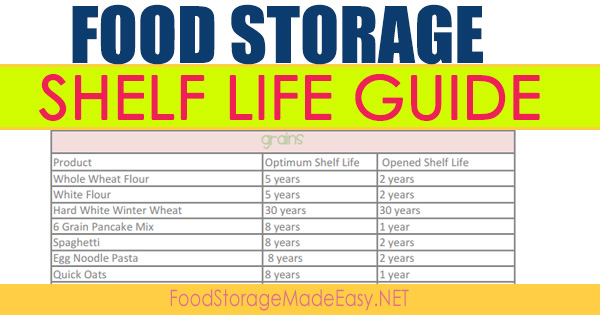
We put together a little handout that gives shelf life for most of your Food Storage Items. We took the information from Thrive Life’s guidelines on their specific products. We thought it would be handy to have it all in one simple chart rather than have to look at each item individually when making your plans.
Click here or the image below to download the Shelf Life Handout

Food Safety Throw Away Guidelines
As food ages it naturally will change in flavor, odor, and texture. The worse these conditions are the less likely we will be to eat a particular food, but if it were safe to begin with, and it passes the following food safety test now, then it should be safe. A good rule of thumb is “When in Doubt—Throw It Out.” (This list was taken from a handout produced by the Utah State Extension Service)
The following chart gives throw away guidelines.
1. Food was not processed properly. If improper processing times, methods, and/or recipes were used for home canned vegetables and meats, the jar may be sealed, but the product deadly—DO NOT TASTE—discard.
2. Look for the following signs of spoilage—DO NOT TASTE—discard:
- Bulging lid—lid must be definite concave, and seal cannot be lifted with fingers.
- Milky appearance to liquid—as food ages the liquid will become more cloudy and a residue will begin to form in bottom of jar—this is the food sluffing off, but the appearance should not be milky.
- Mold growth of any kind.
- Slimy appearance or texture.
- Rancid odor—especially in foods which contain any amount of fat, like dehydrated protein.
- Corrosion on inside of can, especially along seam (particular problem with canned foods older than 10 years or so.
- Rust—especially on seam or seal of can.
- Frozen can or bottle—freezing produces hairline fractures in seal and allows spoilage to begin.
- Off-smell—food generally changes in odor as it ages, if the smell has developed to the point it is undesirable.
- Food stored in non-food grade container—the container was not meant for food or once contained a non-food product (garbage bags, garbage cans, cleaning bottles or buckets, kitty liter containers, etc.).

-Jodi Weiss Schroeder
http://foodstoragemadeeasy.net