Key Points:

  • Most sources recommend 1 gallon of water per person, PER day, for 3-14 days.
    (Make sure to consider storing enough for pets as well)
  • Store water in “FOOD GRADE” or PETE plastic containers (stay away from milk jugs, but soda bottles are suitable).
  • Store water away from too much light or heat.
  • Clean, sanitize, and rinse all containers prior to use.
  • Do not use containers previously used to store non-food products.
  • Store water in multiple sizes of containers to suit different emergency needs
  • Do not store water containers directly on concrete. Place on cardboard, wood pallets, or other materials.
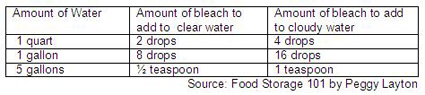
  • Non-chlorinated water (most municipal water is chlorinated) should be treated with unscented liquid household chlorine bleach (5 to 6% sodium hypochlorite). See the chart below for appropriate amount to add to water.
  • Boiling is the safest way to clean water, however you can also use household liquid bleach to kill microorganisms.
  • Rotate your water storage at least once every year

view posts

Diagrams/Charts:


Tools From Our Sister Sites at FunWithFoodStorage.NET:

TheFoodStorageShopper.NET: Buying Water Training Page
EverydayFoodStorage.NET: Buying Water Training Page

Online Resources:

Beyond the BabySteps page – For more advanced water concepts
Water Storage / Purification Handout – EXCELLENT resource by @cboyack which can be printed and added to your Food Storage Made Easy Binder.
FEMA – Official government water storage recommendations
Totally Ready Blog Post – Great tips on storing water
Provident Living – LDS church water recommendations


  • yanamaria13
    I just found your website and it's AMAZING!!!...Thank you for all you do....I have a question that didn't occur to me until reading all the comments. Let's say I store my water in soda bottles or any approved bottle to store it in. I'm using bottled Spring Water from the grocery store and us transfering it. Do I store it and never think about it again until I need it? Or if I use tap water do I still need to clean it with bleach if I'm on city water? And if it is water that requires bleach do I do the bleach one time and forget about it? Do I have to rotate the water or purify it every so often?
  • Melanie
    We are huge seltzer water drinkers. I always buy the 2 liter bottles and then just recycle the bottles. One day it occurred to me why not use the empty bottles for our water storage? So now, every time we finish a bottle I just rinse it out, fill it up with tap water, and add it to our storage. I've already acquired over 25 gal. of water this way and it's practically free since I already had the bottles.
  • Sarah
    By drops do you mean like an eye dropper? Could I use a medicine dropper? I have all these apple juice containers I would like to fill with water storage but I don't want to poison my family either.
  • Yes a medicine dropper would work just fine :)
  • Sarah
    After reading more posts I see that chlorine would be better. How much clorine do I put in 2 quarts of water?
  • Leslie L
    I just discovered your website- this is great! I thought I would share our water storage solution. We have a water cooler in our house (the kind that you usually find in offices). Every 2 weeks we have 5 gallon jugs delivered, and they take away the empty ones. So what we did was order a lot, and then we rotate it. We always at least 30 gallons of drinkable water stored. And we have 2 more jugs that we are drinking. So we always have 8 jugs in the house, and every two weeks 2 of them are empty. Our family of 4 (2 adults, 1 preschooler and 1 toddler) goes through 1 5-gallon jug a week. The delivery service is relatively inexpensive, and we've found it to be cheaper than buying bottles of water. We also have empty containers ready to be filled at the first sign of trouble. We don't have huge amounts of space, we live in a townhouse with no basement or attic, so we store the jugs under our stairs. Not very pretty, but fairly discreet. :)
  • alexandrapearson
    Could you e-mail me the Baby-Step 2 in PDF? I would like to print the checklist without the ads.
    Also, I heard that storing water in clean milk jugs is not safe. Is that true? Why? What would you recommend instead?
  • All of our steps and checklists are available in printable pdf format in our Food Storage Made Easy eBook binder. You can purchase it via the link on the right hand side of our website.

    Storing water in milk jugs is not recommended as those containers will disintegrate and leak after a few months. The plastic is too thin. 2-liter bottles or juice bottles ARE ok though.
  • Any advice yet re: storing water in a car?

    Plastic leaches BPA and other undesirable chemicals, especially when the car heats up >100F, glass has safety (and resultant mess) issues due to breakability, and steel bottles are small and pricey. Right now, I do have one 1-liter steel bottle in my car (and my son's have the same), but that's hardly enough for an "emergency".
  • Kaytee, I'm not sure of the answer to this. If anyone else has any ideas please feel free to share them in the comments. I will continue to research it and post if I find anything.
  • Thanks for checking!
  • Kaytee, I recently came across a product that I think would work well in the car. Check out this link: http://beprepared.com/product.asp_Q_pn_E_KW%20S...

    Since they are not plastic you wouldn't have the trouble with chemicals leeching. Just make sure not to fill them completely full so they don't explode when they expand.
  • I understand the concern about chemicals (I avoid plastic as much as possible), but in the short term of needing safe-to-drink water in the event of an emergency honestly I think that is a lesser concern. I understand trying to find a solution for longer term water treatment or storage but I think for keeping on hand safe, portable, potable water, sufficient for 72 hours, the jugs are probably the best option at this point. Just my $.02
  • Ashley
    I bought the same 7 gallon water containers from Wal-Mart. I bought 6 of them, which gives me the recommended amount of water for my family of 3 for 14 days. Each container was about $9. I filled them all with water, after sterilizing (that was the hard part…I filled the jugs with 3/4 hot water and 1/4 bleach. You can transfer the solution to 3 or 4 other containers, but the bleach made it somewhat messy- my stretch pants have a large white spot on the behind now…I sat in some of the water/bleach mixture). I then filled each container with cool water and ¼ tsp of bleach and I put them on 2x4 wood blocks in my basement.

    Anyway, I filled the containers about 1 month ago, and I noticed they have started to warp. I don’t see them leaking or anything, they’re just starting to tip and bend. Is that normal? Just worried the containers may not be strong enough, safe enough…etc. Thanks!
  • Ashley, We have heard differing comments about the WalMart jugs. We have had ours for over a year now and haven't noticed any warping or leaking. We don't live in an extreme climate though. We are working on researching some other options to let people know about if people want something more industrial. I wouldn't worry about safety in your jugs though, they should be fine to drink even with tipping and bending.
  • Do you know why you can't store it directly on concrete?
  • I just got a 21 cubic foot deep freeze (charity fundraiser for only 50 dollars!) and we are working on getting it filled with food. It works best completely full, but I don't have enough frozen food to put in there yet. For the time being I have filled it with my water storage (in the plastic jugs that the water came in). Has anyone put their water storage in the freezer like this?
  • yes. before i had my baby and nursed/pumped and stored my milk in the freezer, my f-i-l actually stored juice bottles of water in th freezer. these would later be used to keep the super sized igloos cold when on an outing.
  • How should we store water in a car? Plastic will leach undesirable chemicals into the water when it gets as hot as it does inside a car... glass breaks... steel bottles are very pricey right now, and have plastic tops anyway.

    Also-- how about storing food/energy bars, and medications in car-- there's the problem with heat causing deterioration?
  • Hi, just found your site recently. I want to second those who recommend more rather than less water storage, and to prepare to be without power. After hurricane Rita I was without running water for 6 days, and without power for 3 weeks, and we were NOT in the hardest hit areas. Living without power is hard, but living without water is the worst. Being in the south, we needed much more than a gallon a day per person, even for drinking.

    Also--we bought gallon jugs of water, in plastic jugs similar to milk jugs--they definitely disintegrate--after a few months of storage, if you touched one it would sping a leak!

    BTW, I appreciate having access to so much information all at one site, presented in such a fun way!
  • Catherine
    Having been without water for a few days, I can tell you that 1 gallon of water a day per person is NOT enough to drink, cook and clean. My solution to the problem is using 2 plastic buckets (like ice cream ones). I fill them both up about 3/4 full. One is for soaping up and the other is for rinsing off hands. The next day the rinse water becomes the soaping water. The used soap water can be used to flush toilets or even wash clothes. You could use 2 more buckets for washing dishes, if you're not using disposables.

    Another thing I do is to keep my liquid laundry detergent jugs. I fill them up with water and I have soapy water for washing! You would still need to add a little bleach to keep it sanitary. The push button spouts can be used to put the water where it's needed.
  • great idea!!!
  • Jodi -- Food Storage Made Easy
    Thanks for the tips Catherine. 1 gallon per person per day for 14 days is the minimum recommendation. It's good to know that it would be better to store more.
  • Jennifer
    I just want to add 2 cents in here. Water storage containers can be found in Wal-mart, K-mart, any camping, RV, & most hardware stores. Online sources are Emergency Essentials, BePrepared and most "survival" outlets. Try GI Joe's, REI, military surplus stores, etc. Store water AND a filter, the best you can afford!

    3 days is the low end estimate of Red Cross or other help reaching you. Take lessons from recent disasters- it takes much longer than 3 days in some cases, especially if the disaster is still ongoing i.e. aftershocks, fires, severe rain, etc.

    REMEMBER: YOU CAN LIVE MANY DAYS OR WEEKS WITHOUT FOOD, BUT YOU CANNOT LIVE WITHOUT WATER PERIOD.

    Best thing to do is start - it will add up! Giving up 2 lattes a week will buy 1 (Wal-Mart price) 7 gallon jug. I priced them two days ago. Trade off? Prepared with peace of mind. Can't beat that!

    I love the site, and the links. Ladies thank you for all that you are doing to help us all get the rear in gear! (Boy did I need that kick in butt!)

    Happy Mother's Day to you all!
  • Toni
    I have been told that you shouldn't fill your large water barrels with a garden hose. What do you know about this?
  • Christina
    Most garden hoses are considered nonpotable, in other words, the material the water passes through is not food-grade. You can purchase a potable grade hose though; we did that for our birth tub. Got ours at a standard hardware store, nothing special.
  • lacee
    I bought 2 55gal drums thatt had fruit juice concentrate in them. Can I still store water in them if I add bleach?? Won't the bleach kill any bacteria from the left over juice? Or are these useless:(
  • Jill in Canada
    I just found out about your site. THANK YOU!

    I have a large water storage container that I filled 2 years ago. I always thought that I could boil the water from the container before drinking it. From reading the comments, that might not be the best way to do it?

    What I would like is a pump to pump the water through the container and into my washing machine so the water in the container is always fresh. Have you ever heard a pump like that?
  • Jodi -- Food Storage Made Easy
    Jill, It's always best to put in fresh water that has been treated with bleach if necessary. You never know in an emergency if you will be able to boil water. It's better to be safe than sorry! It seems like I have seen a plastic tube that you can attach to the large blue water barrels that might be able to pump out the water. I actually don't use the large barrels so I don't know first-hand what all is available. Welcome to the site!
  • Kristine
    If we have those six gallon containers from WalMart & fill them with water from our Reverse Osmosis system, do we need to add bleach?? I don't think it's chlorinated because of the filtration but I know it's pretty pure. Just not sure if it can be stored as is or needs bleach. Thanks.
  • Jodi
    Kristine, I'm not a purification expert, but I think the point of the bleach is so that you are storing pure water and it will keep it pure for about a year or so. I think the filtered water would be ok in the beginning but if it has taken the chlorine out then it might not KEEP the water pure over a long period of time. If you are worried, it never hurts to add the bleach just to be safe. Or you could do some with it and some without and test the water after a year.
  • Shelly
    I purchased a lot of water a few months ago. About 30 , 2.5 gallon containers. Problem is...I have been storing them all in a nice straight line along the wall (which is concrete), and on the floor (which is concrete). What does this mean. Is it all garbage now? What exactly is the risk? Can I fix it? Thanks.
  • Jodi
    Shelly, if you are worried about it, just empty the containers and refill with fresh water. Then make sure to put something underneath them next time. I don't know the technicalities, but I would guess that for just a few months it would probably still be ok, but just to be safe it wouldn't hurt.
  • Carol
    I just found your website and love it...thank you. I have been buying water jugs (2.5 gal.) at Sam's club. Do I need to rotate these? Can I keep them forever and just add water purification tablets to it?
  • Kristin
    Hi - how do I know if my water is chlorinated? (FYI - I live in SLC, UT)
    Thx.
  • Tracy in Utah
    You may have mentioned this and I missed it. Remember no plastic container is dense enough not to have chemicals leach through it over time. So the regular bleach bottle will lose about half its clorine in 6 month. In a year most of the clorine is gone in a bottle of bleach. The clorine is what purifies the water ,so use new bleach. Another way is use pure clorine that can be bought at stores like Walmart for pools. It comes in dry form so it lasts much much longer.
  • Jodi
    Heather, I think a vinegar bottle would work great. I've kept bottles of vinegar for longer than a year and they've been fine. Also the bleach bottles would work too. Anything that is designed to be for shelf stable liquids should be the appropriate grade of plastic.

    Vicki, Thanks for the reminder, we talk about not using milk bottles up in the main points above. They are definitely NOT good to use for long term water storage.
  • Vicki
    One thing I haven't seen addressed is concerning storing water in milk type jugs. They are designed to be biodegradable, and tend to spring leaks after a couple of months. (I learned the hard way many years ago.) The 2 liter soda bottles and juice bottles (PET or PETE will be printed in the recycling triangle) are a better choice.
  • Heather
    I just noticed that my white vinegar bottle is the same grade plastic as bleach bottles. Can I use this as well??
  • Heather
    When I was pregnant with my second child, our laundry room was three floors down. I was so lazy about laundry that I never threw away my laundry soap jugs, I just stacked them on shelves. They really added up fast! I was wondering if I could start saving them again for water storage. Of course, I would only use the water for flushing toilets, laundry, ect. I hardly ever buy bleach so that wouldn't add up very fast for me. I would assume that they are made out of the same plastic as the beach bottles. I love your site, thanks for all of the great information. It has been extremely helpful!
  • Theresa
    Thanks for your help Jodi!
  • Jodi
    Theresa,

    My containers were 7 gallon containers so I just did the 1/2 teaspoon. I don't think it's a hugely exact science. I have read that if there is a bleach-y flavor you just move the water back and forth between two containers a few times and it will evaporate out. Also i think the bleach dissipates over time too. That's why you are supposed to change the water out every year or so. Hope that helps!
  • Theresa
    I have my water containers to cover us for 14 days, but before I fill them I have a question about the "drops" of bleach to add. What size dropper do I use since droppers can be calibrated for different volumes? Is this information available somewhere using metric system measurements like milliters? I do not want to over bleach the water. Thanks for all of your help!
  • UtahChic!
    I'm not new to emergency preparedness, so I can answer some question that aren't answered above.
    The Red Cross suggest a 3 day supply of water but the church suggests a 14 day supply...better to be safe than sorry, right? I would prefer to have one 55-gallon drum for each member for a month but most people think that's a little radical. Just remember that if it was a major disaster and you were unable to use running water you would need water not just for cooking and drinking but for cleaning dishes, brushing teeth, cleaning your body, cleaning clothes, etc. If you think about how much water you use everyday it makes perfect sense to have that much on hand!
    As for storing water on cement; after time the water will start to taste and smell like what it is surrounded by. This is why you want to store water off the ground. Also if your storing it in your garage keep fuel and lawn agents away from it as well. In an emergency it would be hard to down a glass of water that tastes like cement or fuel. If it's a 55-gallon drum; store it on a pallet a few inches from the wall and try to keep things stored in a different location.
    If you decide to store your water supply outside, keep in mind that the sun will cause a green algae to form in your water. This isn't bad for you but to keep your family from being grossed out it's best to keep a couple packages of green Kool-Aid on hand :) Also the container you use to store your water can be a new or used container but you don't want to use a container that has ever held anything but water in it. Plastics absorb whatever is being stored in them so if you've stored food in the container, even if you've cleaned it, after a years time you will start to see 'floaties' in the water. The plastic is releasing those substances and they will start to form bacteria making it unsafe to drink.
    If you needed water for longer than 14 days you would have to find an alternative water supply, i.e. streams, water heater, etc. in this case you may want to consider that electricity may not be available either so you may not be able to boil your water. If you choose to use bleach remember that there is only 5% of chlorine in bleach, which is what kills the bacteria and harmful things growing in your drinking water. Chlorine evaporates so after a years time there is no longer any chlorine in a container of bleach. Even if you do choose to still use bleach you'll be left with the other 95% of harmful agents in the bleach. The best way to treat water is to use a spa essential brand chlorinating concentrate (spa companies carry this, it's used to clean the water in hot tubs) a 2 lb. 95% or higher chlorine concentrate in a powder form will treat a year supply of water for a family of 5. The average cost for one container is around $17. You can purchase 100 chlorine test strips for around $7. Just add ¼ teaspoon of chlorine for a 55-gallon drum of water. Mix the chlorine and water and seal the container for 24 hours. Follow the test strip directions. If after 24 hours the water is still not clean add another ¼ teaspoon to the container and test the water again in another 24 hours. Leave the lid off for another 12 hours for the smell to dissipate. Boiling your water at an altitude (such as Utah) you would need to boil it for at least 22 minutes. If you use bleach, you are left with harmful agents in your water and you have no way of testing the water to make sure it's clean. Using powdered chlorine you can test the water with chlorine test strips and you'll know when it's ready to use, it's also under $25 to do so.
    I hope this helps, it goes a little beyond what you've covered. All of your information is wonderful and I'm glad that there are people out there willing to educate and pass along what they know to make it easier on others! I remember feeling very overwhelmed by all of it when I started and I wish there was something like this back then! But it's true that it's better to start small than not at all! :)
  • outstanding information! thank you!!!
  • Rebecca in Brigham City
    WOW! Thanks for the powdered chlorine information. I didn't know about the impurities in bleach and would have blissfully used it in water storage not knowing I could be harming my family!
  • candace
    I've really enjoyed all of the great tips and the discussion in general.
    Also, don't forget about any animals you may have.
    We have dairy goats and laying hens as well as a dog and a cat. They would need a great deal of water as well, esp during the milking season!
  • Angie
    Where did you buy the 7 gallon water jugs and how much did they cost?
  • Angel
    Kristen I store bottled water. I buy a case most every time I go to the store AND bigger bottles I have found.
    Its just more expensive so I think these are more cost effective suggestions.
    As long as its stored I dont think it matters.
  • Kristen
    Would it be fine just to buy bottled water? Not sure if someone asked about it, but I didn't see it as I was scrolling through :)
  • Hi, I'm new here, and have done emergency food preps because of living on the coast, and normally try to have lots of food, but now I'm going to try for a 3 months supply and am going to use your fun site and excel sheet as my guide.

    I'm not an expert when it comes to emergency preparedness, but I am experienced: I've been through 2 hurricanes, evacuated hurricanes 2 times (neither hit), and have had water in my home 2 times. I can't begin to count the number of times we've lost power for 4+ hours just from thunderstorms, and one lightning strike to our transformer.

    I learned some preparedness from my mother who grew up on an island up north that occasionally had hurricanes. When Alicia formed 3 days out, she filled cardboard milk jugs with water and put them in the freezer. Meanwhile, she fixed as much freezer and fridge food as possible so she wouldn't lose as much food, and to have more room to put the frozen containers.

    Since 2 lt plastic soda bottles came out, I save them every spring to have on hand in case I need them for the freezer. They drove my husband of 9 years crazy, until Ike, when we didn't lose very much food because we had more time before it went bad, plus we had cool potable water without me having to go to the food lines every day just for ice and water.

    I also turned the fridge as high as possible the day before Ike, and covered the fridge with every blanket possible once we lost power.

    I also saved many 1 gallon glass bottles, which I cleaned and bleached, then filled to use for coffee. We were the only ones on our little dead-end block that could make coffee with our campstove and camp-percolator, and we went through ALL the water I'd saved in the glass in about 5 days because of making coffee for the neighbors. It was a good trade though, because they'd bring us home ice from their jobs (hubby's job didn't give out ice, in fact I had to send extra food for lunches quite a few days).

    With Alicia '83, it took about 4 days before water was declared safe; TS Allison was maybe a day or more; and Ike was about 10 days in Houston. So unless you want to be dependent on the kind helpers and government, I'd recommend a lot more than just 3 days worth of water storage. Remember you're going to want to wash clothes and dishes during this time too.
  • TracyinSC
    Wow. Great ideas Morning Sunshine. Thank you for sharing!
  • Morning Sunshine
    Since some of your water storage is to be used for cooking, store liquid chicken or beef or vegetable stocks. That will give your rice/beans/dehydrated vegetables a tastier flavor and added nutrients. I am not advocating doing this totally in place of water, but in addition to.
    In that vein, your canned vegetables and fruits (tomatoes, green beans, peaches, etc) also have water in them that would be great in cooking instead of plain water. Use fruit juice to cook your oatmeal, or tomato juice to cook your rice. And that leaves more of your 14 gallons of clean water for drinking or cleaning.
    To Tracy: A good way to rotate your water is to use it on your garden during the summer. I have done the "store your water in empty canning jars" method which is great, and then, as the summer comes to an end, use those to water my garden just in time to fill them up again with produce. And as I eat my produce throughout the winter, I fill the empty bottles with water until the end of summer. It is a great way to rotate.
  • Angel
    I have been storing cases of water bottles and jugs.
    I will be getting bigger containers and we want to build a storage tank up on the hill to catch our spring overflow. It will be naturally gravity fed.

    The original safety plans were for 72hrs.
    The 'powers that be' have admitted that although that is a great start, you should really have at least two weeks supply for your home keeping your 72hr kits ready for an evacuation if needed.

    So do both.
    Start with 72hrs kits/bags and expand to the 2 weeks at home use.

    I too have heard not to store your water OR food on concrete directly.
  • Pam
    I love your website. A friend from church showed it to me and it is really helping with our preparedness classes at church. Thank you for your time and help. There is so much information in this site that it is taking me a while to go through it. Thanks again, Pam, NC
  • TracyinSC
    Sigh. No Macey's out here. We do have Macy's department store, and I have a feeling they don't sell water storage stuff...

    Question about the bottled water: I have purchased a good amount of 1/2 liter bottles when on sale, and I'm wondering if I have to rotate those every once in a while. And when I do, can I just refill them with tap water? Then, once it's tap water, how often do I have to rotate THAT?

    Thanks! Tracy
  • Michelle B
    Oh, one more thing...

    Macey's is having a big food storage sale including water drums, buckets, etc. Thought you might want to know.
  • Michelle B
    Sorry if you already answered this, I was to busy to read through all the posts...

    I was not aware of the not putting your water storage directly on concrete so I have several bottles on my basement concrete floor. I want to make sure to be safe, so can i just empty them and refill them with clean water, or do i need to throw out all the bottles that have been sitting on the cement and start new?
  • Jodi
    John, thanks for the great tips.

    Mary, that is a fabulous idea! i have a whole shelf of empty jars taking up space right now. I'm going to fill em up for sure!

    Erika, are you worried we are going to yell at you about storing water? Hehe. A couple things to consider for YOU in particular. You probably still want to have some stored in your car kit or disaster kit. If you have to evacuate quickly and have to head a direction without easily accessible water that may be a consideration. If you have space to store some more water I'd still do it (you never know if there could be an emergency where you are trapped in your house, you are injured, etc.). But it is true if you have an easy access to water you might not need to stress about it AS much as other people. We like to keep our recommendation to store water so that people don't try to justify a way out of it (i.e. I COULD walk to that stream that's 2 miles away ...). And for situations like the hurricanes those people could not access fresh water for up to a week. Having a supply in their house would have been HUGE! Thanks for the tips on the filters too, we will be discussing this more later this week.
  • Erika
    I Love your site I just stumbled on it after messing around with my food storage closet! ( I googled years supply of food worksheet and found the 3 month one!) Ok so I was looking at the baby steps! Our ward just had a R.S. on food storage and in particular water. I know you laddies are stressing actually storing water which I think now after reading your site and the comments is something I need to do. The gal that taught the lesson went to REI they sold her a water filter. But then she consulted with and avid backpacker in our ward and she said that a water purifier is what you really need! The difference is in the microns it filters down to and the fact that the water purifier filters out viruses. She demonstrated the difference with red soda, and the purifier filtered to just plain water and the water filter only really weak red soda. I probably still need to store water but here in the California, Central Valley we have ag water and canals so in a disaster I could get water and we have several lakes near by so a purifier is really handy. So for people like me in an upstairs apartment with no real storage and afraid of stored water leaking I will be buying a purifier soon the one used at the demonstration was by a company called First Need I am sure you can find others. Just a thought for those close to water that can't store vast amounts a purifier is great idea.
  • Mary Lee
    If you do home canning, you probably have many bottles of fruits and vegetables in your storage. When you use the product, wash the bottle thoroughly and fill it with water, put the lid back on, and put it back on the shelf. The bottle is going to use the shelf space anyway, so why not have it filled with water.
  • John
    A couple of points. First, make sure any old barrels didn't contain anything nasty in them, even food based stuff like syrup as it will add a flavor to the water.

    Second, as Misty said, if you have to evacuate your house because of tornado, forest fire, or earthquake, you cannot manhandle a 55 gallon drum quickly or safely. Make sure you have sufficient water in small containers to last for 3 days per person.

    While part of your gallon a day is assumed for washing, I'd be sure to add wet ones or other moist towelette for cleaning to avoid wasting water.

    Don't forget the idea of rain barrels. If that is too expensive, keep some brand new plastic sheeting which you can put on your roof to help catch rain without collecting asphalt in it. Lay it out and bend the corners in to make a funnel for your containers.
  • Tracy
    I inherited two 55-gallon jugs from a friend who was moving. Don't know how old they are, but they're white plastic. All the ones I see lately are dark blue. Is there a color preference? Will these older ones still serve our needs just fine? (Of course, any water is better than none, but is there a preference?) I do intend to store drinking water in smaller containers as well. Thanks!
  • molly
    What about using non-chlorine bleach? Will that work as well for purifying water?
  • jweiss08
    Thanks Misty, Jodi and I appreciate when some experts share so kindly their knowledge.
  • Misty Sutton
    The best game plan for storing water is to store it in many different sizes and types of containers. For example, can you imagine what would happen if all you had was one larger container holding your entire 14 days of water and it either sprung a leak or got severly contaminated? Spread your storage out over large containers, 5 gallon or 1 gallon size containers, and even store-packaged bottles of water if you like. Also, according to emergency preparedness experts, culinary (tap) water should not be purified until before you are ready to use it rather than before you store it. Purifying chemicals eventually wear out, and bacteria can grow. As for water purification systems, experts do recommend storing at least 3 to 14 days worth of water and to purchase water purification tablets or systems to use beyond the 14 days. In your planning it is important to consider local water sources you would use close to your home, such as springs or pools. Some areas around your house that you don't usually think about include, the toilet tank (not the bowl), your water heater, a water bed, and even rain water.
  • Jodi
    Thanks for all the great comments and tips guys. That's a great idea to use milk jugs/old bleach containers for flushing toilets or washing dishes, etc.

    Valerie - When we developed this page everyone was recommending 14 days but it seems like they've changed now to say "at least 3 days".

    Natalie, Valerie, Emily - I can't find an official source but we have heard from several of our readers that storing the jugs directly on concrete can cause chemicals to leach into your water and also weaken the plastic causing the containers to leak. There is some great info a this site http://blog.totallyready.com/?p=15 with more details. Natalie I would get a wood pallet for your 55 gallon drum, that's what my mother-in-law uses.

    Emily - Heat and light increase the rate at which plastics will decompose. So if you know it will be hot, get heavy duty plastic jugs instead of thinner containers like soda bottles. Also, I'd check and replace the water more often in that situation.

    Hope that helps a bit! Keep the questions coming :)

    -Jodi
  • Emily
    Great site. I am working on getting my water supply stored. Assume I have used the proper containers and am storing them on a shelf. I live in California and it gets VERY hot in the summer. My house is small. Can I store water in the garage? Is heat detrimental to stored water? I am also interested in the answer to Natalie's question.
  • Natalie
    Hi Ladies,

    Love your site! Quick question....I have a full 55 gal water drum stored directly on concrete...will I have a problem? Please expand

    Thanks!!
  • Heidi
    In reference to milk jugs - definately not good for drinking water - but we do store some for toilet flushing in case of an emergency where the water is turned off. We don't want to use our good drinkable water for that function. If you have a pool in your backyard, you wouldn't really need to worry about flushing water. We have also thought that milk jug size will be easy to pour in the toilet if ever needed. Thanks for all your great information!
  • Jayne
    You guys are great! When I was young...well, I don't know what I did when I was young...But don't forget your bleach bottles. (if you have the space...) when you are done with a bottle, (completely empty) fill it with water, cut off the label and write 'water' on it with a permanent marker. it takes about 2 seconds everytime and I have many bottles (I'm really old...) in my garage of water to flush toilets with, wash dishes with and etc. It has the residual bleach left in it and I would probably drink it if I had to. The bottles are dark which is also good. tip: shake your storage water before using to add air so it doesn't taste 'flat'. You probably already knew that! Great job...keep up the good work!! P.S. I have 3 (unmarried) kids in college in 3 different states...I am making the 'milk jug 72 hour kits' for them for their cars for Christmas...shhhhh...Their only job is to keep their gas tanks full so they can get home immediately in case of an emergency (no waiting in line for gas!!!)
  • Valerie
    I had it in my head that I should be storing 14 days supply of water, but when I looked at the FEMA and Red Cross websites, they only recommended "at least" a 3 day supply. Could you tell me some of the sources where you found the recommendation of 14 days? (I'm preparing info for others for a R.S. mtg. and want to make sure my sources are sound). Also wondering what your source is for the recommendation to not store plastic water containers directly on concrete floors. I hadn't ever considered that as a risk before. Thanks for all your work at compiling information.
  • Jodi
    Debbie, From what I have read glass bottles are fine for storage. I don't think the color makes a difference. If you already have chlorinated water you don't HAVE to add bleach, but we like to do it just to be on the safe side. Just follow the diagram above to get the correct amounts. Hope that helps.
  • Debbie
    Can i store water in dark glass bottles? I have been doing this, but didn't know I should add chlorine to my filtered water that I filled them with. Can I add it later?
  • jweiss08
    Dina,
    Good question. Those water jugs can be used if you replace them every six months or so, or if they are food grade plastic. In all our research we found that storing water in "milk" jugs isn't a good idea because the plastic isn't strong enough. Evaluate the grade of plastic, if it's like a milk jug, replace them every 6 months. If it's thicker, like a soda bottle, every year is probably good.
  • Jodi
    Terry-

    Thanks for the tip, but we STILL stand by the recommendation to store actual water. I saw on the news today that people in Galveston, Texas are still without access to food and water and it is 10 days into their emergency. How wonderful would it have been if they all followed the recommendation and had 2 weeks of water on hand. I know that humanitarian groups have come in to help them, but isn't the point of food storage to be self-sufficient? A water filter can definitely be useful but please do not consider it as a replacement for actual water, it should be used in ADDITION to your water storage.
  • Dina
    Hey,
    I am real new to this. I am starting to make my 72 hour kits. Now why can't I just use a jug of water bought from the store rather than the 2 liter soda bottles?
    Thanks for the great website!
  • Terry
    A less expensive way to go is this filtered water bottle. We gave one of these to all of our kids (and ourselves) for Christmas last year. They're great in a 72-hour kit also -- in addition to some regular bottles of water. You can shop around or just go to this URL: http://giardiaclub.com/water-bottle-filter/inde....
  • Jodi
    Hi Denny,

    We actually don't recommend storing 1500 gallons of water. If you view the key points above you will see that we recommend storing 14 gallons total per person. This is what most emergency organizations suggest. You might be home-bound for a period of time, or need to grab a bunch of water and leave your house quickly. Obviously for a longer-term emergency you will have to have a back-up plan for your water situation. That goes a bit beyond being EASY and will be discussed in the future when we get into advanced techniques beyond the baby steps.

    Thanks for sharing the link, we will consider that as an option as we explore water storage further. But for now we are sticking with the recommendations here as it is very reasonable and will help in a lot of situations.

    -Jodi
  • Denny
    There is a company that just invented a great device. Greatly reduces the need to store large quantities of water because it purifies it. I have NO affiliation with the product, but you can check it out at http://www.lifesaversystems.com/
    I think we'll get one just because it's easier than trying to store 1500 gallons of water.
  • Jodi
    Hi Valerie.

    If you don't have naturally chlorinated water you will need to add bleach. Our water in Utah is chlorinated but I added the bleach just to be safe, it can't hurt. So if you use the chart we posted above, you can figure out how much to add. 5 gallons = 1/2 teaspoon. So 55 gallons = 11 1/2 teaspoons or 5 1/2 teaspoons. There are 3 teaspoons per tablespoon so I'd just round up and put in 2 tablespoons for the 55 gallon barrel. Hope that helps!
  • Valerie
    I have a 55 gallon water barrel. Do I add bleach to it to when we fill it? If so, how much?
  • Jodi
    Cecile,

    Thanks for your input. That's definitely something to consider for people who don't have a good water source. In the future we are planning to talk about how to purify water in case you run through your stored amount. That could be especially important in your situation!
  • Since our water in NJ is nasty, we have water delivered. We had them deliver extra containers at the beginning for water storage. When they deliver a new water bottle each week we use the older bottles first. Instant water storage!
  • jweiss08
    We clarified the instructions. Thanks for the input. We went into further detail in our game plan, but if the first part wasn't perfectly clear, we're glad you pointed it out.
  • Michelle
    You girls have a great site here, I'll be passing it along. I wanted to point something out to you about something under your "Key Points". It says "1 gallon per person for 14 days". It should say 1 gallon per person per day for 14 days. It kind of sounds like all you need is a gallon of water to last a person for 14 days. Not to be knit picky, but I know you want to put accurate information. I'm sure it was just an over site.
    Thanks for your hard work, it's going to help a lot of people.
    Michelle
blog comments powered by Disqus

Please note: we reserve the right to modify or delete any comment that is inappropriate, promotional in nature, or offensive. Please be considerate in your remarks.