How to Create an Emergency Binder

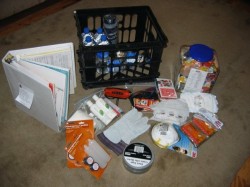
What is an Emergency Binder? As we talk about under Getting Started, each family should have a disaster kit put together which includes things like first aid items, 72 hour food kits, extra outfits, etc. An emergency binder is an integral part of this kit. Basically you ask yourself this question: Would I be frustrated or mad if I lost this item in an earthquake, flood, or other emergency situation?

What should I include in my Emergency Binder?

  • birth certificates
  • passports
  • social security cards
  • copies of your credit cards front and back
  • homeowners insurance policy
  • auto insurance policy
  • life insurance policy
  • bank statements
  • retirement statements
  • internet passwords (banking, personal, work etc)
  • immunization records
  • utility statements
  • work/tax documents that would be difficult to replace
  • CASH – keep a variety of small bills on hand

We like to put each item in a sheet protector and add divider labels to put them into sections. This makes it easy to pull things in and out when you need to access them.

Do I store copies or originals? This is a personal choice but we recommend storing the originals IN your emergency binder and store photocopies of them in a filing cabinet, and also scan a digital copy and give it to a trusted friend or put it in a safe deposit box. If your house burnt down or was flooded it would be so relieving to know that you don’t have to go through the hassle of replacing those documents. If you already have a water/fireproof filing cabinet or safe you may choose to just put copies in your binder so that you can have the information on hand in an emergency but know that you can return home and find the originals intact at a later time.
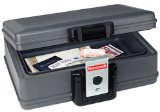
What should I store my binder in? Even though the idea is to grab the disaster kit and bring it with you, there is always the chance that you won’t be home during an emergency. In this scenario you would still want to return home and find your binder in good condition (especially if your original documents are IN the binder). We recommend storing your binder in a fireproof/ waterproof locked box that is small enough to be transported with you in an emergency.

P.S WE ARE GETTING A LOT OF GOOD IDEAS IN THE COMMENTS HERE, MAKE SURE YOU READ THEM.

Technorati Tags: 72 hour kit, disaster kit, emergency binder, Emergency Preparedness

  • libertyRN
    One other thing, and if it's been posted before I apologize.

    In getting ready for a disaster, it's important for insurance purposes to have photos of your house. For proof of what you had. We are all told when we buy homeowners/renters insurance to document serial numbers and other identifying information of each high-price item.

    My friend is an insurance adjuster and has said that often people don't have any proof whatsoever that there was once a house standing in a disaster zone. None of us wants to deal with more heartache and stress after a disaster. So take a digital camera and snap photos of every room in your house. You want different angles of each room, even the ceiling and floor (goes to prove there wasn't damage there already). Take pictures of your house from outside, again at different angles. If you own a collection or any kind of collectibles that are especially valuable, you should also take a picture of the inside of it.

    And once you're done, be sure to keep a copy of these pictures. Either back them up to Mozy, keep them on a flash drive, memory card, or keep some sort of copies in several places. You could even print them out and keep them with your emergency binder. Then you'd have them, along with your insurance information and contact info if needed.

    Hope this helps.
  • Elisa
    I was just watching the news and in Chile they had buildings that were leaning and the people had to give a list of things they needed out of their apartments and it clicked. as prepared as we should be we need our families to know WHERE things are that we need in an emergency and someone else has to help us. I just moved ALL the things that if needed I could tell someone where they are AND they will be able to get them easily.
  • carol59
    Hello,
    You never sent me check list 2 will you please send it to me.
    Thanks Carol
  • libertyRN
    I just wanted to add, one thing I noticed after Katrina (had a friend who lost it all). Please, please, PLEASE everyone...after you've got the important stuff done, start scanning photos of your family and keeping digital copies on a flash drive. You can then keep extra memory cards, a flash drive, or even CD/DVD's full of pictures in your emergency binder, with your documents, etc. Can you imagine what it would be like to lose your house, and with it...all your family pictures? My friend lost it all, and it truly opened my eyes to how hard it would be to lose my kids' photos, my family/ancestry photos, and other pics that would be forever gone. I myself have all mine stored on a web-based server (like flickr, photobucket, etc), on Mozy, in CD's, and I have two flash drives that so far have ALL my photos I have in my house. All of them. I carry one flash drive with me in my purse, with all my digital copies of documents (encrypted), and all my GOOD photos. My friend has NO pictures of her family, none of her children, none of her wedding, nothing. It breaks my heart. I know it may be overwhelming for people, but even if you just start copying SOME pics, and doing some every week, that's a start...and at least you'd have some memories left. :) Great comments, everyone...and THANK YOU for this site and all your HARD work!!!
  • karenshine
    When you say, "policy" referring to homeowners, auto and life, are you referring to the one-page printout of the policy numbers and basic coverage amounts, or are you talking about the whole packet with detailed coverage?
  • Blane888
    I agree with Anita; especially if you are keeping all of these documents in your car. All it takes is one car break-in and there goes your identity along with that of your spouse and your kids. Your toast. That is one disaster you won't recover from.

    I would keep sensitive information like this in a secure location in the house. If you have to take it with you some time ..... that works. If you have to return to the house to retrieve it ..... that works too.
  • Yes we recommend placing it in a fireproof, waterproof, portable safe.
  • Sarah
    We only have one family car. Our binder and our "go kit" are both in the trunk. In an emergency, that is the only vehicle that is transporting our family. We have a copy binder in our fire-lock box.
  • Traci
    I would add health records for your pets. You may need to prove that fido has updated shots for shelters, etc.
  • Catherine
    You could always "hide" your documents in a photo album or a scrapbook.
  • Todd
    Frankly, just getting people to locate and collect all these items will be a huge benefit to them, even if they don't make a binder or fire safe. So thanks for that encouragement.

    I would be very careful, though, about putting all this information in a binder and sticking it where somebody would easily access it. There are too many ways people (even with our permission) get into our homes. Best that this is hidden somewhere nobody would immediately look.

    An alternative is to scan all these items and back them up to Mozy, which you could access from any computer anywhere in the world after the fire/tornado/hurricane/etc. Then all you'd need to actually carry would be passports, immunization records, and other items not of interest to identity thieves.
  • francines
    I like the idea of scanning documents, but many times you need the actual document(marriage license). Perhaps scan as much as you can and have it on a flash drive...then carry the rest in an 5 x 7 "address book" with papers folded once.
  • Sarah
    Some additional things in my binder:
    my certificate of citizenship (which is theoretically irreplaceable)
    I also planned to put in some how-to stuff on dealing with emergencies; how to purify water with bleach, things like that...i'm still working on it

    Thanks for all your work!
  • Marie
    I would also add an itemized photo card, most digital cameras have them these days. Take photos of everyone in your family, including pets. Then label all of the photos with the person's name and any other identifying information (say SSN, school or workplace contact data, RFID for pets, etc.). You can also take picture of valuables that cannot travel with you in the event of an emergency, while many have done so already for insurance purposes, to speed the process in the event of a disaster.
  • Julie
    I have to add adoption certificates to that - especially if your child is a different race than you! In an emergency situation, it may not be clear to others who is your child legally.
  • On top of that list I also have:
    A copy of my church membership records
    A ward list
    An emergency sheet on each family member. It has a physical description, photo & any other info that would help locate them in case of emergency.

    I keep mine with my 72 hour kit so it is remembered.
  • Admin
    We totally AGREE! SECURITY is a MAJOR issue for us all to be cautious of, but for a lot of young families starting out to invest in burglar rated fire safe that is bolted to a concrete floor, or encrypted waterproof USB flash drive for portable copies - can be enough of a hang up that they don't do ANYTHING at all.

    So if this stuff is just going to sit in your filing cabinet anyways, maybe have it sit organized so it can be grabbed quickly in case of an emergency.

    The main focus of our entire blog is to get started somewhere, obviously the very start of anything wont be the IDEAL, but you can't get to the ideal if you don't start small.

    We'll be focusing on more advanced concepts in the beyond the babysteps portion blog as we get to it, but for now everyone, do something, anything small, just get started :)
  • Angie
    Another thing to consider is putting ID info. for each family member in it. A current picture, lock of hair, fingerprint, name, weight, height, hair color, eye color, any other descriptions in case of separation, etc. Just a thought. I have a lot to get done!! Thanks!
  • Brian
    I'd add titles/deeds to that list.

    Personally I'd be wary of keeping all of those items in anything with a carry handle on it that can be smacked open by any thug with a hammer...

    For me. a burglar rated fire safe that is bolted to a concrete floor is the right place for originals. Encrypted waterproof USB flash drive for portable copies.
  • Lacy
    All of this information is a tiny bit of an overload for me but I am so excited. I have tried unsuccessfully for years to ge prepared but I couldn't wrap my brain around the organizational part by myself. Thank so much for all of your help. It's like preparedness for dumbies and I love it!
  • Anita M. Estes
    A question about the binder. Isn't this making it very convenient for a thief? Everything a thief needs to steal identities is going to be in one container should someone decide they want to ruin your life. Birth certificates, passports, credit card numbers, checking account numbers, internet passwords, etc. Wouldn't these things be better kept in a bank safe deposit box instead?
  • Kylene
    My husband and I were brainstorming last night for anything else that might also need to be included. We came up with marriage documents, health insurance policy, list of (or copy of) prescriptions currently taking, and also any warranties on big household items that we buy.
  • Sydney
    I am so glad that I found your website! It is going to be so helpful! Food storage scares me...i had no idea where to start, what to get, etc.! I have also been looking for a fireproof/waterproof box that didn't cost tons of money. Thanks for posting the link to the one you did!
  • Gwen
    Another thing to consider, not necessarily IN an emergency binder, but certainly with emergency supplies, is a prioritized list of household items to grab in case of disaster. Obviously your emergency kits are your number one priority, but if there's time, other things such as family photos, journals, family history stuff, camera, etc. can be taken too. By having a list made ahead of time, if something happens, you can simply go down the list, gathering the things you can (in order of most important) instead of running around in a panic and forgetting something important to you.
  • when i was growing up my grandmother would go all over the house and touch what she would take in the event we had to leave in an emergency( lived within 10 miles of power plant). she said if we had 15 minutes to get what was needed and get in the car and leave we had to have a plan. we did this every month. we never worried about the animals. Thanks for reminding me they will be with us and to have what they need too. We take comfort in our pets and have to have them ready to go or just enough for a 72 hour kits of their own. Thanks for the ideas.
  • heatheranne
    there is a wonderful binder system established at flylady.net - she calls it her "control journal". In addition to a wonderful template to get you started, she sells a great binder that zips to keep documents secure and also has a handle so you can literally grab and go!
  • Admin
    I bet that kind of binder, with how to's exist, we'll have to look into it and share it...
  • Amanda
    Good idea!!! I also like the idea posted by Lisa about a "How To" binder. Looks like I need to get to work!
  • lisa
    Great idea! I'll have to make a binder for my family.
    I also thought it would be handy to have a "how to binder" in case of disasters. So I have put together a binder full of information on what to do if disaster happens. Things on:
    Pandemic, fire, snow storms,tornadoes, even spiritual preparedness and more because you can never think strait when it's happening to you.
  • Mariah
    never thought we might actually be looking at that info in our binders, but here we are in the beginning of a pandemic right now, so even if we think "oh it wont happen any time soon..." it could because it did. so we need make sure we all have it ready to look at at any time!!
  • Lindsey
    We also have a document in all the family member's kits with family contacts since most live far away and we'd need to let them know how we're doing- addresses, phone numbers and also a recent family photo in case of a missing person report and can't get access to a computer/internet.
  • Admin
    Good call Allie. I have those account numbers on my internet banking passwords sheet so I don't have actual statements in my binder. I actually put a LOT of things on the internet banking passwords sheet. I went ahead and included the utility statements in this list though.
  • Adding to my previous post, in addition to the list of items listed above, I would also include bill statements. That way, you would have the account numbers and phone numbers for utilities, phone service, etc.
  • Thank you so much for posting this advice. You've made it very easy to set up an emergency binder. I went ahead and labeled each sheet protector instead of using dividers.

    Thanks again!

    Allie
    Learningtobefrugal.com
blog comments powered by Disqus

Please note: we reserve the right to modify or delete any comment that is inappropriate, promotional in nature, or offensive. Please be considerate in your remarks.