
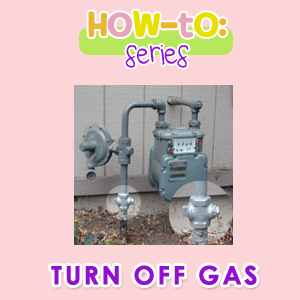
HOW-TO: Turn Off Natural Gas
In case you didn’t see the link on our Facebook Page, we were recently featured on the Prepper Podcast. In listening to the show, we realized that there were a lot of things that we claimed to just let our husbands take care of that could actually be problematic in an emergency if they weren’t home. So we decided to ask our handy (and handsome) husbands to teach us some of these things that we’ve always “left to them” in the past.
And of course, we wanted to share these “HOW-TO’s” with all of you so that you can be prepared too. (If you have already purchased a Food Storage Made Easy Binder we will DEFINITELY be including these as handouts in the free updates). So let’s get started!

In the event of an emergency, if you have identified a potential natural gas leak, it is important to shut off your natural gas and then report the leak to 911 or to your local gas company. Here is a quick video showing how to shut off your main gas valve as well as the gas to your furnace/water heater.
How to Identify an Outside Gas Leak:
- Hissing, roaring or blowing sound
- Dirt being blown into the air
- Water being blown into the air at a pond, river, or creek
- Continuous bubbling in wet, flooded areas
- Fire at or near exposed piping
- Flames apparently emanating from the ground
- Dead or brown vegetation in an otherwise moist or green field
- A “rotten-egg” odor (this is the most common sign inside your home)
Important Reminders:
- The gas company has to come and restart your service if you shut off the gas, so make sure you only do it IF you identify a leak. If there is no leak then it is not necessary to turn off your gas.
- If a gas leak is discovered, turn off any potential “ignition” sources and evacuate everyone from the area
- Do not attempt to make repairs or extinguish fires

Filed under: Emergency Preparedness, How-To Series


Thanks! My husband is military, headed off for a 3rd year-long deployment, and it's so handy to know stuff like this!
This stuff is great to know! I think there are several men & women out there who need to learn this stuff! Thanks!
Some husbands don't know these things either. Just being male doesn't guarantee you would know. How come Mike knows all this stuff? Guess he's one of those lucky guys that can be both HANDSOME and HANDY.
our natural gas thingy was changed without our knowledge ha ha and now you can't turn it off, it can only be turned off by the company, because people were turning them off needlessly and it takes a technician to safely turn them back on. So go out and look to see if you can EVEN turn it off.
Maybe its because I grew up with oil, but I dont trust natural gas. When we had gas in my other house, we had propane. I just dont like the idea of possibly losing my heat like I lose my electricity. I like the idea that I can keep my oil tank full and no matter what happens, I at least have that much oil that I can ration and live off of until things go back to normal i.e. a big ice storm, hurricane, etc. Even with propane, you have a tank on your property. It just feels more prepared to have tanks of things, than just a line heading into your house.
When I read the title to your article, I thought you were teaching a class on the proper way to cook beans! ~smile~
hehe Linda
Thank you Jodi and Jodi's handsome hubby and Julie for the video. I have never thought about this ….very good info. that all women NEED to know how to do. I will have my husband show me about ours. You ladies do such a great job. Thank you!
yeah I'd rather have propane than gas for the same reason, also we have a fireplace on every floor including basement and it has a fan system attached so we COULD heat our house with wood, other than you always smell like you've been camping and you need to de-forest the mountains to get enough wood.
Thanks for posting this. As far as my emergency preparedness goals go, my two big projects are rotating my water and learning when and how to turn off my utilities. This is perfect. Thanks for the tips!