
How to Pressure Can Chicken

Depending on where you are in your food storage journey, you may or may not have considered adding canned meats into your storage plans. When I started to work on my three month supply, I realized there were very few meals in my regular cooking that are purely shelf stable. It seemed boring to just have chili or spaghetti for every meal in my plan, and I wasn’t getting all of the benefits of stocking up on my regular foods. I decided I would count freezer foods in my three month supply planning, and that helped a little bit. But over time, especially as I’ve gotten more comfortable with powerless cooking, I’ve realized that I would really like to have some better shelf stable meal options just in case of a powerless emergency.

Last month I experimented with pressure canning ground beef for the first time … and this month I ventured into the world of pressure canning chicken. It was soooo easy! For a quick review on pressure canners, view our post on pressure canners versus presser cookers. Then come on back and see how easy pressure canning chicken is!


How to Pressure Can Chicken: Raw-Pack Method

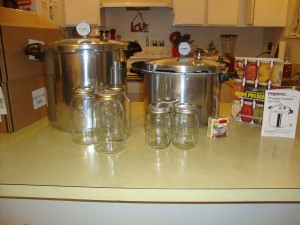
All the tools you need to get started!
Step 1: Wash all jars, lids, and rings. No need to sterilize them for pressure canning. Keep them at room temperature.
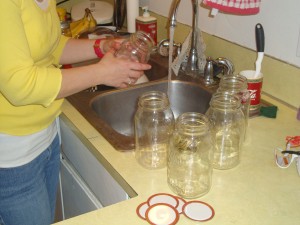
Step 2: Start water boiling to fill the jars with.

Step 3: Cut up frozen chicken into bite-sized pieces. (Let it thaw for just a little bit so it isn’t TOO rock hard)

Step 4: Throw the chicken into jars, fill it all the way to the very top.
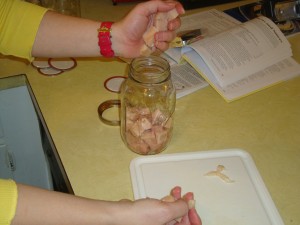
Step 5: Fill each jar with hot water leaving 1 inch of open space at the top of the jar. Poke down any chicken that is sticking above the water.

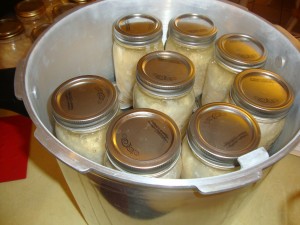
Step 6: Put all the jars into the pressure canner and pour in 3 quarts of boiling water.
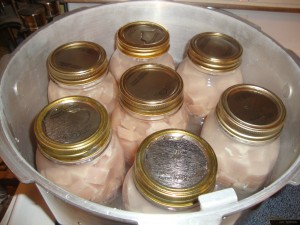
Step 7: Place lid on the pressure canner and turn up the heat on your stove. Allow steam to vent out for ten minutes before placing on the pressure regulator.

Step 8: Bring the pressure up to the correct amount for your elevation (mine was 13 pounds pressure). Process for 75 minutes for pints and 90 minutes for quarts.
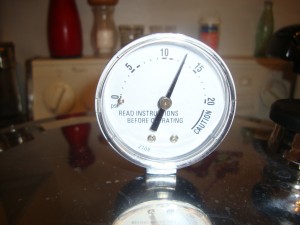
Step 9: Remove the pressure canner from the stove and allow pressure to come down naturally. This can take a long time so be prepared to wait. Remove the pressure regulator from the vent pipe, wait 10 more minutes.
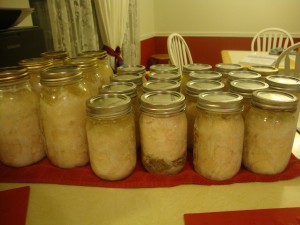
Step 10: Remove jars from canner and allow to cool. Then check the seals, label them with the date canned, and ENJOY!
Please note: I followed the directions in my manual and in my Ball Canning Guide. Your manual may be different so make sure you double-check before you do this on your own!


This entry was posted in Canning, Self Reliance and tagged , , , , . Bookmark the permalink.
  • Emmy

    I did not add the water, I followed my Ball book, and my quart jars are 1/2 full with chicken and broth. All are sealed, but there is so much space, I am worried that they are no good. Anyone know if the space is okay as long as the jars are sealed?

    Emily

    • http://foodstoragemadeeasy.net Jodi and Julie

      I think when you don’t add water you end up with a lot less broth, that’s why I chose to add some water in mine. I think it is ok as long as the seal is good!

  • Beth

    PLEASE NOTE: in step 7, showing the jars in the canner just before putting the pressure canner’s lid on—this picture shows the canner crammed full of jars–this is not a safe canning practice, especially with low acid foods.   It is VITAL that visible space be left between jars to permit the circulation of water, and heat so that botulism and any other harmful bacteria are destroyed!  Why take a chance with your family’s health just so you can get one more jar in??  I never put more than 5 jars in my pressure canner–4 around the outside and one in the center.  Please check this out with your local Ag. Extension Service office or the Ball Blue Book.  Thanks!

  • susan

    Is it possible to can already cooked chicken?

  • http://foodstoragemadeeasy.net Jodi – Food Storage Made Easy

    Michelle, Thanks for the tip. However, my Ball canning guide specifically says to fill the jar with broth or water. I didn’t have a single jar not seal in both batches I did. Liquid is sucked out of the jars no matter what with the pressure canning process due to the changing pressures, so I am not sure that having more or less liquid to start would make a difference? I’m not an expert so I just go by what my book says and I have two books that both said the same thing.

    As for cutting up my chicken, I guess that is personal preference. I use chopped chicken in many recipes and I love the consistency I got from pre-chopping these. Plus it was really easy to chop since they were partially frozen. I think that is just personal preference. I’d rather chop them first than try to shred them or pull them apart out of the jar. I want the quick easy dinners when I’m using them :)

    • Tdjants

      I agree with you on the water, you need the juice to touch all of the meat while boiling.
      that is why you want to take a plastic (not metal) knife or other scraper and slide between  the meat and the glass and press toward the center to release any air bubbles that may be trapped.

  • Wendy

    Thanks! I did put it in the fridge. Just didn’t make sense though lol

  • Wendy

    Great tutorial, thank you! What about this?…When I removed my jars, the juice in one of them wasn’t boiling like the others. My husband checked the temp with his laser thermometer and they were all the same. Is the non-bubbling jar fully processed? Do you know why it wouldn’t boil like the others? Help please lol… I’m new at canning. Thanks!

    • http://foodstoragemadeeasy.net Jodi – Food Storage Made Easy

      That’s way weird! Has the lid remained sealed and everything? I don’t see
      how it wouldn’t be fully processed, since it processed for the same time as
      the other bottles. If the seal popped and everything looks fine I would
      think it’s ok. But if you are worried you could stick that bottle in the
      fridge and use it first. Maybe someone else might have a better answer …

  • Lisa

    Question! I tried doing this for the first time today, and realized that the seal on my pressure canner wasn’t tight. The jars were in the boiling water for over 30 minutes, half of the jars were sealed… but what do I do? Is it safe/cooked fully? I’m so confused!!!

    • Ali R

      No it’s not fully cooked!  You need to get it to pressure and maintain it for 75 min for pints… 90 min for quarts.  It takes a long time for mine to get to pressure.  I imagine it probably boils for a half hour before it hits pressure.  I think you’re just making the preliminary stage!

      • Lisa

        I ended up taking it out of the jars, and just boiling the chicken, since it was still half-raw. It was a sad day… discovered that the canner isn’t seal-able anymore…

      • Lisa

        I ended up taking it out of the jars, and just boiling the chicken, since it was still half-raw. It was a sad day… discovered that the canner isn’t seal-able anymore…

  • Kelara1

    Awesome video! I just wanted to say, I love canning! I have a gas stove and I still have to keep adjusting the temperature to stay at the right pressure so it probably isn’t much better than electric. Also, when raw packing chicken if you pack tightly and remove the air it will completelyt fill the jar with broth when you pressure can it without water. If your jars are only partilly full of broth when you are finished try packing to meat tighter.

  • ginger

    I am beginning to make my own dog food and have canned my first batch of chicken thighs for the pups. I wanted the bones to be soft like the chicken wings dog food in the cans i have bought at the gourmet dog food stores, ( for like $3.00 a can) but mine bones were not soft but still hard. Should i have cooked the chicken first before canning instead of canning raw chicken? The hard bones can not be eaten by the dogs and have to be removed but the soft ones are safe to eat.

    • http://foodstoragemadeeasy.net Jodi – Food Storage Made Easy

      Yikes I have no idea! Maybe someone else might be able to help …

    • Kristina

      are you really sure the bones are hard?  I’ve pressure canned legs and thighs before, and the bones felt hard until you broke them apart with your fingers:)  I hadn’t thought of giving the bones to the dogs – I’ll have to do that, I’m not giving them my chicken!  yummm….

  • Learningtoprep

    Thanks so much for your videos! I just purchased a Presto canner and am ready to try my hand at canning some chicken. I saw that you added boiling water to your raw pack chicken but I’ve seen instructions that say not to add liquid to raw pack. I was wondering if you’ve tried it with and without water, and if so, which did you prefer?

    • http://foodstoragemadeeasy.net Jodi – Food Storage Made Easy

      I added the water because I wanted more broth and because it made more sense
      with the frozen breasts. My books do say that for raw packing you can just
      pack them in tightly and can without adding water. I haven’t tried frozen
      without water but it would be an interesting experiment.

  • Gregandpammcgahey

    The chicken doesn’t look “cubed” anymore…it looks more soupy…so, just wondering what dish you would make with this canned chicken? :O) TY! Pam

    • http://foodstoragemadeeasy.net Jodi – Food Storage Made Easy

      Pam, It is chunks of chicken just kind of smashed together. When I pull
      them out of the jar I just separate them and they are perfectly chunked. I
      save the broth for soups, etc. and use the chicken in anything that I would
      use regular cooked chopped chicken in. I have a lot of recipes I use it
      for, and also throw it in Chicken or Tuna helper and it is just perfect. It
      is really good chicken!

  • Spitchtara

    I happened upon this page about a month ago, and I am happy to say that because of this article I decided to FINALLY go out and buy a pressure canner. Since then, I have canned lots of chicken and beans and have experimented with pressure cooking. I am soooo happy I found your site. Thank you! :)

    • http://foodstoragemadeeasy.net Jodi – Food Storage Made Easy

      I LOVE hearing feedback like this. I’m so happy you tried it out and
      had success! I was so scared at first but now I almost ONLY use my
      canned chicken and ground beef. It’s so convenient and yummy.

  • Fitzmcgre

    I just watched your video about canning the chicken and found it very helpful. I plan to dust off my pressure cooker now thanks to you. But one question; I notice that you have a smooth top stove. I have heard that it is best not to can on smooth top as it can crack the stove top. Have you had any problems?

    • http://foodstoragemadeeasy.net Jodi – Food Storage Made Easy

      My pressure canner specifically says it is ok for use on a glass top
      stove. I have water bath canned and pressure canned on mine with no
      problems. I have heard that the main concern is with the canners
      being full you need to set them on the stove carefully or just the
      weight of it could damage the stove. I have an older stove so I was
      ok with risking some damage, but so far have had no troubles!

  • http://homesteadgardenandpantry.com/ Grannymiller

    Good job!
    You’d save a little time if you raw pack instead of bother with hot water or broth. Either way your chicken looks good :-)
    All the best,
    GM

  • MamaB

    I find it handy to make 1/2 pint jars for a lot of things. Still use the pressure and timing for pints.

    Also, I like my chicken browned a bit first. (All of my meats, actually, especially Pork Shoulder.) Just grill or toss in a hot skillet until brown, then go on as usual. I like to put just a pinch of chicken bullion in there as well. Makes the broth tastier.

  • Debbie

    I have a Presto canner that has raw pack instructions for chicken/poultry, and it says NOT to add extra water with a raw pack (only with hot pack). This is because the raw chicken produces its own liquid when cooking/canning. I am a big fan of canned chicken. So easy to add to a meal when you’re short on time and don’t want to have to thaw some chicken and cook it! :)

    • MammaB

      I have done both, broth added or none. If you add no fluid the jar ends up about half full of natural broth, but the top of the food will begin to look dry after a few months on the shelf. You can turn the jar upside down, then back again every few weeks to avoid this, but who needs the extra work. If you add at least a half-jar of broth or bullion when filling, it all works out better in my opinion. Besides, the broth is usually good for wht you’re making of this.

  • Amy

    Canned my first chicken today…looks beautiful! Can’t wait to try it. Thanks for the prod to actually can meat. I did hamburger earlier in the week. Did the boiling instead of frying it. Next time I think I’ll fry some just to see if the texture is different…seemed very “soft” and gritty for lack of a better word. Any thoughts out there?

    • Karen

      This is an old post, but had to agree with the ‘gritty’ comment of Amy’s regarding canned burger…and I fried mine. DH told me ‘no’ on the canned ground beef (but he loves the canned chili and salmon) so I’ve promised to at least try to disguise it better. I think I’ll stick to prefrying it with onions and garlic, then freezing it in ziplocs. I can still throw it into dinner fairly quickly. It is just dependent on electricity to keep.

  • Anonymous

    This will be a good project for next week-end.

  • Anonymous

    Approx. how many pound of chicken breasts for each pint jar? I want to put up some chicken too. My canner can hold 9 pint jars.

    • http://foodstoragemadeeasy.net Jodi – Food Storage Made Easy

      It was a little less than a pound per pint. I think if I had let the chicken thaw more I could have packed a pound in them. But I loved how easy the frozen method was.

  • Shaunyo

    Jods, You look superduper skinny! Way to go. I can’t wait to share your post with everyone I know. I did chicken this fall and am in love!! Macey’s has chicken this week (Jan 26-Feb 2) for 1.29 lb in 40 pound box. So get to it people!

    • http://foodstoragemadeeasy.net Jodi – Food Storage Made Easy

      Thanks Shauntell! That is bad news about the chicken though, I am sooooo busy this week but now I want to do more! haha.

  • Josraclee

    AWESOME-you make everything look so simple. Thank you and I will be trying this on Saturday!!! :0)

  • TK

    I did my first raw pack chicken this month in pints. Chicken tenders went from the refrigerator straight to the jars with no liquid and 1/4 teaspoon sea salt. They turned out great and made their own broth. :)

  • Jenmcmurtrie

    What is the texture of canned chicken like?

    • http://foodstoragemadeeasy.net Jodi – Food Storage Made Easy

      It seemed just like boiled chicken to me, which is what I end up using in a lot of my casserole recipes anyway.

  • Vmfisher

    For those in northern Utah, Maceys will have their boneless, skinless chicken breasts on sale Jan. 26- Feb. 1; a 40 lb. box will be $1.28/lb. ($51.20 for the box).

    • http://foodstoragemadeeasy.net Jodi – Food Storage Made Easy

      Awesome! I may have to do some more chicken!

  • http://mamas-mission.blogspot.com/ ChefMama

    I can’t wait to catch chicken on sale again!

  • J-newbie

    This seemed like a “mysterious process” until now, Your text and pics demo is excellent!!

    Q:
    Does anyone use chicken broth in the jars (instead of water) or a combination of water & chicken broth? Do you ever add some basic spices (pepper, dried garlic and/or basil, and perhaps salt)?

    I’m asking because we find that regular grocery store chicken seems to have no flavour unless it is marinated or spiced up. We’ve purchase organic chicken occasionally (price & availability issues), but I have to say the difference is flavour is significant; i.e. actually has a taste of chicken!

    Thanks very much
    J

    • Cobbsmom

      I have added spices and other ingredients to have a seasoned meat. I canned chicken topped with salsa for a Mexican flavor but you need to add additional salsa because what is in the canning jar will be mushy, but still flavorful.

      Meats release their liquids during the canning process, so the spices and other vegetables will be diluted some. So just adding water and a little salt will create a concentrated broth. You can use tomato juice/tomato sauce with Italian seasonings. DO NOT USE sage – it gets stronger during the processing.

      The only time I have chicken broth to can is when I cook a whole chicken in a pot of water. This usually produces 4 quarts of broth as well as the pulled cooked chicken. I hold back enough for dinner and can the rest, using some of the broth for the cooked chicken and then can the extra broth in separate jars. I use the broth for soup starters and for making gravy.

      What applies to chicken, also applies to beef and pork. Personally, I like to can pork in a mixture of water and vinear because we usually make barbecue. You can also can the meat in a barbecue sauce but it will be soupy and need to be cooked down once opened.

      Just a note – meats have to be processed for 75/90 for pints/quarts no matter their proportion in the jar.. Most vegetables will be very soft/mushy.when processed for this length of time. The only exception I have seen in the Ball’s Blue Book is the Meat Sauce recipe, page 62, which is processed for 60/75 min for pints/quarts.

      • http://foodstoragemadeeasy.net Jodi – Food Storage Made Easy

        Wow, I’m glad we have a resident canning expert in here! Thanks for your great comments :)

        • Cobbsmom

          Jodi – I am not an “expert”, just passionate about canning. What I share is what I have learned, usually the hard way. It thrills me to no end to see young people do this. I didn’t start canning until I was 50. I have been canning now for over 8 years. I joined your blog to learn to better organize what I have and to better understand those areas I am weak – such as wheat storage/use. I just feel we are all experts at something and sharing what knowledge we have helps us be better prepared and take better care of our families. There are some things I have canned that are not recommended but I like to know why. I am not embarrassed to tell you my failures as well as my success.

      • J-newbie

        Thanks so much Cobbsmom … great information! Sorry for being so late coming back to this topic, but I’ve copied it over to my folder so have it on hand for next time.

    • http://foodstoragemadeeasy.net Jodi – Food Storage Made Easy

      As the chicken cooks it turns in to chicken broth. I think you could for sure add spices, I was just too lazy to try it this time. I want to add in dehydrated onions and celery to make a nice chicken soup base. Maybe next time!

      • J-newbie

        Oh, that sounds good … adding onions & celery :-)

      • Midge

        A warning with spices, they get more potent with pressure canning, so use a little less than you would cooking fresh. Also, green herbs such as sage and tarragon can turn bitter. Save them to add later. Using a pinch of bullion kicks up the flavor well. I add that, and less on the salt.

        • http://foodstoragemadeeasy.net Jodi – Food Storage Made Easy

          Great tips. Thanks!

        • http://foodstoragemadeeasy.net Jodi – Food Storage Made Easy

          Great tips. Thanks!

  • Heather

    I am very interested in this… what is the shelf life of the chicken?

    • Cobbsmom

      All your canned foods should be rotated within a year. Label the jar with the content, date and processing time. Some write on the lid with a Sharpie, I make rectangle labels that I use clear packing tape to attach to the jar. The important info to have is the contents and date. When you place the jars in your storage room, place the newest jars in the back, just as you would your commercially canned foods.

      As you can probably tell, I am very passionate about this subject! It delights me to see young people consider this option for saving money and preparing for emergencies. Canned foods cannot be moved as easily as freeze/dried or dried foods but they are wonderful staples for the home.

    • http://foodstoragemadeeasy.net Jodi – Food Storage Made Easy

      I have heard 1-2 years. Although some people say they have had it last way longer than that. I plan to rotate through within a year just to be safe.

    • MammaB.

      The USDA, and the American Canned Foods Association says commercial canned foods are safe to eat so long as the can is uncompromised (no sharp dents, leaks, bulging, rust). For most, they begin to loose taste, texture and nutrients at about FIVE years. Very old canned foods may be sanitary to eat, but will look and taste poor, and have little nutrition.
      The USDA says properly processed home canned goods can be considered to have the same shelf lives as commercial, though they “recommend” using them in one to two years. (Just to be on the safe side, I suppose.)

  • http://www.facebook.com/profile.php?id=1419009325 Anonymous

    Thank you for this post :) I just bought 40 lbs of chicken and am planning on canning some of it. I have no experience canning, though. This post will help a lot. One question though…when raw-packed, does the chicken get cooked and is it safe to eat straight from the jar without cooking it?

    • Cobbsmom

      USDA recommends that all canned foods be boiled/cooked for 10 minutes prior to eating. Personally, I don’t always do this. I always smell and check the jar for any odd smells/fuzzy things. I have had jars of vegetables pop open and after a few days you will think you have something dead in the storage room and go looking for the cause! I have never had any meat lose a seal.

      This brings up a great suggestion I was given when I first started canning – remove the rings. You need to be able to clean around the lids with a soft nail brush and wash the jars in warm soapy water before drying, labeling and storing. Caked on foods are an invitation for rodents, ants and other bugs. Having the rings off also helps locate when a jar has opened because the lid will come off easily. The only time I replace the rings is when transporting the jars or giving to others. This allows them to store leftovers in the jar.

      Good rule of niceness – put a label on the jar that you wish it to be returned – especially jelly/jam jars – with a promise to provide a refill. This may get more jars back to you.

      • http://www.christinehudnall.com Christine – Hammock House

        Another reason to remove the rings (although what Cobbsmom brought up some good ones!), is because of rusting. Yes, depending on how long you have them, where you live and where you store them, rust can start. That not only will make it that much harder to get off, but, it can actually pop the seals.

        As Cobbsmom said, the only time I put the rings on, is for transporting or giving away to others.

    • http://foodstoragemadeeasy.net Jodi – Food Storage Made Easy

      The chicken was completely cooked. In the meals I’ve made with it so far I have heated it up at the end of the recipe. But I don’t see why you couldn’t eat it straight out of the can since it already cooked for 90+ minutes….

      • cindy

        I have canned my own chicken and we use it straight from the jar. It makes great chicken salad for my kids lunch sandwiches mixed with some mayo and seasonings. They also put it on crackers for a snack.
        When I use it for something else, of course it gets heated up again but it is not necessary.

  • Cobbsmom

    Beautiful work! You will find lots of recipes for using the cooked chicken. I make casseroles such as chicken divan, enchiladas, and soups. I did 10 quarts of chicken thighs this weekend. One bit of advice I would offer is to always use wide-mouth canning jars. It is easier to remove the meat. I can the chicken thighs (removing skin but leaving in the bone for flavor) because they are the cheapest cut in my market (98-cents/pound). Also I have found no difference in taste and only slightly softer texture if you cook your meat before canning rather than canning raw meat. This makes a great option for leftovers, especially if it is a recipe that your family has never eaten. You can can the meat with or without water but I think covering with water (salt is optional) makes for a moister meat. Most of my canned meats are done raw and no seasoning so I can use it in any recipe.

    For easier cleanup of the jar, you can spray the inside of the jar with cooking spray. Canned meats tend to cling to the sides of the jars. With the wide-mouth jars, I can get my hand inside with a plastic scrub pad to clean before placing jars in dishwasher. If you used regular jars, I recommend using a wooden spoon to help swish the scrub pad on the inside. Just placing the jar in the dishwasher will not clean it completely.

    • Cobbsmom

      I forgot to add – I have canned on an electric stove and a gas stove. On the electric stove I had to remove the full canner when finished because it cools down slowly. If you have a gas stove (which I currently have and love), you can leave the canner on the burner and just turn the gas off. It takes 45 minutes for cool-down, sometimes 60.

    • http://foodstoragemadeeasy.net Jodi – Food Storage Made Easy

      Thanks for the tips. I dont have any wide-mouth jars so I just went with what I had. I’ll have to try to get some! We have already started using the chicken and I just love it!

    • TammyB

      A baby bottle cleaner works the best for mason jars. They are pretty inexpensive too.

    • TammyB

      A baby bottle cleaner works the best for mason jars. They are pretty inexpensive too.