
Purchase your legumes and learn how to use them: dried beans, bean soup mixes, lentils, soy beans, etc. Since legumes are mainly used as a source of protein, you may also wish to add some meats to your storage as an alternative protein source.
Key Points
- Beans, peas and lentils are the richest source of vegetable protein and are a good source of both soluble and insoluble dietary fiber.
- Utilizing dried beans and soaking them overnight is the best way to get the true bean flavor and a smooth texture
- When legumes are eaten with grains, nuts or seeds, a complete protein can be formed which can suitably replace meat, fish, poultry, eggs or dairy.
- Legumes aren’t just used for soups. Some other uses are:
- Grind into bean flour for white sauces
- Mash up cooked beans to replace butter/oil in recipes
- Grow into sprouts for a fresh “vegetable”
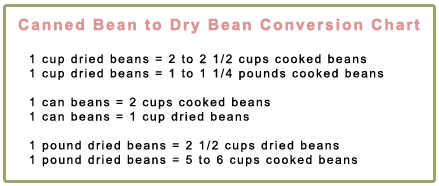
- One easy way to start using dried beans is to use them in place of canned beans in your normal recipes (see conversion chart below)
- Generally, legumes will keep indefinitely when stored in a cool, dry place.
- Meats can be used to supplement or replace legumes as a protein source in your storage. Meats can be stored in the following ways:
- Canned meats (either purchased or home-canned)
- Dehydrated meats (beef or turkey jerkey, either homemade or store-bought)
- Freeze-dried meats (many varieties available to purchase)
- Fresh meat from animals you raise
- Determine the quantities of each food item you will need to store. For more information, see BabyStep 4.
Helpful Hints
Since the bulk of the recommended legume storage is beans, here is a basic summary of Do’s and Don’ts.
BEAN DO’S:
- Store dry beans in a cool, dry place.
- Lightly rinse packaged dry beans; sort through them and remove any pebbles, seed pods, leaves or twigs.
- Soak your beans! It reduces cooking time by about one half, and saves vitamins, minerals and proteins which can be lost during prolonged heating — exceptions are lentils, split peas and black-eyed peas which may be cooked from their dry state.
- Soak beans in plenty of water. Use a 3:1 or 4:1 ratio of water to beans (see chart for soaking times).
- Place presoaked beans in a pot and cover with fresh, cold water. Bring to a boil, reduce heat, partially cover and simmer them for the indicated length of time until they are soft and tender.
BEAN DON’TS:
- Store dry beans in the refrigerator.
- Add baking soda to hasten soaking or cooking time as it will decrease the nutritional content of the beans.
- Add salt or any product high in calcium, magnesium or acid to the soaking or cooking water or beans will not soften (products with these elements should be added to cooking water or any recipe calling for partially cooked beans only after beans have reached desired tenderness).
- Use microwave to cook dry beans – microwaving is fine for reheating beans that are already cooked, but dry beans need to be simmered slowly in lots of water to soften, tenderize and rehydrate properly.
Dry Soup Mix
- Soup mixes are used to flavor soups made with your beans.
- There are many types such as chicken base, beef base, ham base, onion soup mix, cream based.
- If you want to create your own mixes visit allrecipes.com.
Dried Beans Overview
Dried beans are a great source of protein, especially when combined with a whole grain. They have a long 30 year shelf life and can be used for many things. Here is a list of the most common types of dried beans:
Pinto beans, Black beans, Red beans, Navy beans, Kidney beans, Garbanzo beans, Great northern white beans, Lima beans, Mung beans, and Soybeans
Alfalfa
Alfalfa is a member of the pea family and is typically eaten as sprouts.
Uses: Alfalfa sprouts can be used to top sandwiches and burgers similar to lettuce. They are also good thrown into salads or soups. You can even set them on a plate and use as an edible garnish for a main meat dish.
Health Benefits: Alfalfa contains high levels of phytoestrogens, saponins, and antioxidants.
Lentils
Lentils are small, flat legumes that come in a wide variety of colors such as red, green, brown, yellow, etc.
Uses: Lentils can be flavored many different ways. You can make a sweet salad by combining them with fruits, or a savory soup or casserole. They can also be used as a meat filler or substitute to add bulk to your meals.
Health Benefits: Lentils are high in fiber and magnesium, yet low in calories and fat.
Split peas
Split peas are regular peas that have been dried after harvesting. After they are dried and the skins removed, they split naturally. They can usually be found in both yellow and green varieties.
Uses: The most common use for split peas is the famous split pea soup. You can also make a puree of cooked split peas as a side dish, or make “dahl”, a traditional Indian dish.
Health Benefits: Split peas (like lentils) are high in fiber and low in calories and fat. They also provide a good source of 4 minerals, 2 B-vitamins, and isoflavones.
Diagrams/Charts
More Information

Where to Buy Legumes
 |
 |
 |
Helpful Products
 |
ELECTRIC PRESSURE COOKER: You will use your dried beans much more often if you have a good (and fast) way to cook them. An electric pressure cooker allows you to skip the soaking step and fully cook them in 1-2 hours (depending on the variety and age of the beans). |
 |
WONDERMILL GRAIN MILL: An electric mill will enable you to easily grind up legumes to use for bean flour. |
 Hi there! I’m Jodi. I share my preparedness adventures via the blog and social media so you can see what I’m working on day to day.